From the original volume
The book behind the record.
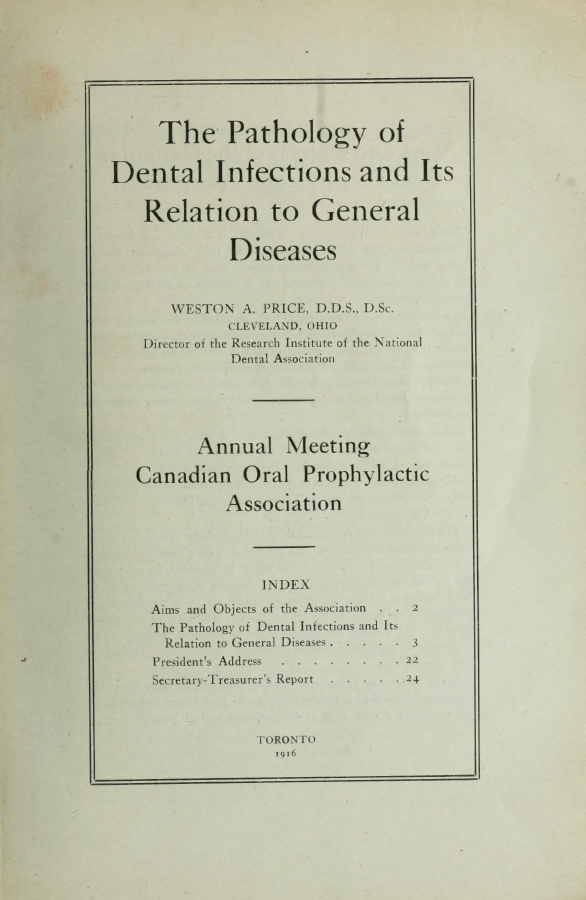
This cover is taken directly from the preserved source, with its original lettering and library marks retained.
Read the preserved original
24 scanned pages · 3.6 MB · PDF
Bibliographic record
- Author
- Weston A. Price
- Catalogue date
- 1916
- Type
- Book / edition
- Subject
- Dental infections and systemic research
- Publication year
- 1916
- Record ID
- wap-book-pathology-1916
Catalogue notes
1916 separate publication of Price’s address, with additional meeting material by A. J. McDonagh and the Canadian Oral Prophylactic Association. A related microform copy is catalogued as cihm_97434.
Sources & provenance
Preservation details · pathologyofdenta00pric.pdf
- Retrieved
- 2026-11-28T02:44:48+00:00
- Original URL
- Open source file
- SHA-256
673359a35e37f18f00f219ba78ea4a52efc9ca87cc820f27b49d2e81fb27b087- Local file
- pathologyofdenta00pric.pdf
- Publication / reuse
- Original publication before 1931; institutional scan with publication date in Internet Archive metadata. US Copyright Office: https://www.copyright.gov/what-is-copyright/
Read searchable text
    The Pathology of
Dental Infections and Its
  Relation to General
         Diseases
       WESTON       A. PRICE, D.D.S., D.Sc.
                 CLEVELAND,       OHIO
  Director ot the Research Institute of the National
                  Dental Association


       Annual Meeting
 Canadian Oral Prophylactic
         Association


                         INDEX
   Aims  and Objects of the Association   . . 2
   The Pathology of Dental Infections and Its
     Relation to General Diseases             3
   President's Address                                 22
   Secretary-Treasurer's Report      .   .   .   •   r .24


                      TORONTO

                          1916
  Aims and Objects of the Canadian
    Oral Prophylactic Association

IN the year 1 905 a committee of dentists of Toronto was formed to
    communicate with the manufacturers of the tooth preparations then on
    the market to ascertain the composition of each, because they believed
that a dentist should not recommend any preparation of which he did not
know the ingredients.
   Finding there was no satisfaction to be obtained in this direction as to
the formulae of these preparations, arrangements were made to have them
chemically analyzed, thus ascertaining that in most of the samples were
ingredients which should not exist in an ideal mouth preparation.
   The Canadian Oral Prophylactic Association was then organized to
have manufactured preparations which should contain nothing which was
not beneficial.
  After much consideration and consultation a paste was manufactured
under the registered name "Hutax" (meaning mouth health). Later a
powder was placed on the market, and last a tooth brush.
   These articles are the result of frequent consultations with many of the
leading practitioners, not only in Toronto, but of the Dominion of Canada
and the United States.
   The shareholders of the Canadian Oral Prophylactic Association origin-
     ally subscribed $5.00 each for "the good of the cause," and the charter of
incorporation provides that the profits are to be expended for educational
and philanthropic purposes, such as (a) bringing prominently before the
public important information, which the dentist has, as to the influence of
conditions of the mouth on the general health. (b) Care of the teeth of
the poor, (c) Assisting the indigent in the profession of dentistry. Thus
no director or shareholder receives directly or indirectly any dividends or
other remuneration.

   Every dentist may recommend "Hutax" preparations with a confident
consciousness that there is nothing better on the market, and that the profits
will be utilized for the good of the profession and of humanity.
The Pathology of Dental Infections
    and Its Relation to General
              Diseases
          Weston      A. Price. D.D.S., D.Sc. Cleveland. Ohio.
   Delivered before the Annual Meeting of the Canadian Oral Prophylactic
            Association and their guests, the Academy of Medicine,
                          Toronto, February 14, 1916.

     Mr. President, — I want to assure you that I come with a very deep
sense of my inability to-night to live up to the standard and desire and
hope that has been thrown out by Dr. McDonagh. I think it is a very
unfair handicap to put upon a man to make such extravagant statements
which of all men I certainly cannot live up to.
     It is, however, a very great pleasure to be here, and I come with a
mingled feeling of joy that I am privileged to come back to Toronto and
be with you again, and feelings of helplessness akin almost to discourage-
       ment when I realize the responsibility that is being thrust upon the dental
profession to-day, and the utter inadequacy of the dental profession
to meet that responsibility. One week ago this evening we had in
Cleveland the opening of the Research Institute of the National Dental
Association, and had as one of our speakers Dr. Charles Mayo, of
Rochester, Minnesota. That splendid orator and magnificent physician and
surgeon reviewed to us in detail the development of modern science as it
relates to the healing arts. He reminded us of the splendid contributions
of the Chinese, of those great contributions of the Greeks, and finally came
down to the present decades and reminded us how one after another the
great scourges, the great besoms of death, had been taken from the earth
by medical science, and then as his climax, said the great mass of people
to-day would not die of one of those plagues, they would die of a simple
infection, that 90 out of every I 00 probably would die because of some
simple infection, the result of a focal infection, which focus itself would
give them no trouble. He then referred to the fact that 90 per cent, of the
lesions, of the focal infections, are above the collar, and of those above
 the collar which would include the tonsils, the antrum, the nasal passages
and sinuses, that for the largest part come from dental infections, oral in-
          fections, and then accepted the challenge of the dental profession that they
are going to take that responsibility. Are you going to do it, brothers?
Recently I have been corresponding with the deans of the universities and
the dental colleges of the country, with the editors of our best journals, and
advertising in our dental journals to find if we cannot get one dozen, or
even one-half dozen, men who are competent to go into the department of
4      Report   of   the   Canadian   Ural   Prophylactic   Association.


research to determine the relation of mouth infections to systemic infec-
        tions. How many do you suppose we could find? I am ashamed to let
you know. There are a few good men who are doing research work, but
we cannot pry them loose from where they are, but alas, the tragedy is we
haven't men in the world to-day; we haven't enough to even do one per
cent, of the work that is demanded right now in interpreting the relation of
mouth infections to systemic infections, and vice versa. Dr. Mayo said
last month that at this moment we should have four dentists to every one
that exists now in order to look after the interests of humanity. Not only
for their own sakes, but for the State's sake. What does that mean? Well,
my dear brothers in the profession, it means we must put our shoulders to
this wheel. We have a great responsibility as a dental profession, namely,
to help interpret the relation of these mouth infections to systemic infections.
He also said to me on that occasion, as he did in Boston some weeks ago,
we have learned as a medical profession doing research as we are in our
institution, that these problems cannot be solved by medical men ; they must
be solved by men with a dental vision. Where are the men with the dental
vision ?
      Unfortunately, when we try to pick out the men with dental vision^ that
is all they have got. Oh, the men with the medical and dental vision are the
men that are wanted ; the man who is big enough to see all the physician
sees, and also see what the dentist sees — these seeing both at once are the
men we need. I visited a hospital in Chicago not long since, and one of
the leading bacteriologists took me through one ward after another and
showed me the many cases that were being treated and helped, because
they had treated the mouth infections, and then we came to a room, and
he said: "There is a great joke in this hospital. We have got to
get a new room to store the teeth in. As a matter of fact we are ex-
        tracting so many teeth in this institution we have really got to get a new
place to store them." I said to him, "What proportion of the teeth that are
extracted in this hospital are in your judgment related to the other infec-
    tion that the removal of the teeth did cure or did relieve?" He said, "I
have thought of that many times, and I have thought that three or four
out of a dozen." The average number of teeth extracted in that hospital
under the direction of the medical men, he said, was about twelve, and in
his judgment as a bacteriologist not more than three or four of the twelve
ever should have been extracted. We are honored, I understand, and I
am glad it is so, to have a number of the medical men with us to-night.
I don't know what your practice is here, but I do know that I go to cities
where the feelings of the medical men sometimes are so extreme as to even
demand that every tooth that has a dead pulp is a menace and should
be removed, and if it isn't giving trouble it may give trouble.
    Now, that is almost as extreme as a physician as perhaps are 70 per
cent, of the dental profession, who rather plume themselves and say. "Well.
         Report    of   the   Canadian     Oral    Prophylactic     Associatioi


 perhaps so and so is not competent to save this root, but I can put a bridge
on that will be all right." I say the dental profession are taking the other
extreme and are saying, or thinking, and are allowing themselves, perhaps,
to be misled — or else they have not informed themselves of the danger
and they are going right ahead and putting dental work on teeth that are
already shortening the lives of those patients.  I believe and know, just as
much as I know I am standing here, that a lot of my dental operations have
helped to shorten the lives of patients.  I would give a great deal if I had
not done some of the work that I have been doing.         I believe absolutely
that I have put bridges on to teeth that already had an infection, and that
were undermining the health of those patients, and I did not suspect it. I
have had the privilege of undoing some of that work, and if God will spare
me I hope to undo quite a lot more of it. To show you that I have not
been a gold crown advocate I may say I have never put a gold crown in
any person's mouth forward of the second bicuspid.     So you see I have
not been a slave to the gold crown habit. I have refrained from devitaliz-
     ing pulps where I could accomplish the result in some other way, but I
have felt I was so skilful that I could attach bridges to teeth that had
deep pyorrhea pockets beside them.       I thought I was so skilful that the
patient ^vas wonderfully fortunate to be in my hands, but I know very well
that they would have been better off in the hands of some man entirely
unknown to the community, but who ^vith his conservatism was satisfied to
practice a great deal less scientific dentistry perhaps but would use the
forceps more frequently than I would.       Well, some medical people will
say, "That is what I expected, and that tooth should be extracted." That
is just as far from the mark as the other statement, for the time has come
when we can distinguish the type which is a dangerous type of infection
from one which is not. Now, which is the greatest tragedy which has de-
              veloped inthis entire field of research during this last two or three years?
I know of none that is so significant and so appalling, because of its subtle-
       ness, as the abscess.          The dental abscess that is causing trouble in the
mouth of the patient is, as a rule, not the one that will be causing arthritis
or myelitis, or a heart affection, not nearly so as that type of dental abscess
that produces no local trouble.                  Let me repeat: Of the last dozen cases
that we have studied and treated for arthritis there has not been a single
exception to the fact that the lesions which we relieved and treated impro\-
ing the patient's condition were giving no local trouble.           Why?  The very
type of infection answers the question.             What do I mean by the type of
infection?           Here we have a rapidly developing abscess with a great deal
of inflammation and pus formation.                We have not got a simple strep-
           tococcus infection; we have a stercoremia infection, with some of the
ancillary contaminations with it. But when we have a pure streptococcal
infection of the type that produces lesions that I referred to, almost in-
           variably, ifnot invariably, they give the patient no trouble. Now, this
6        Report   of   the   Canadian   Oral   Prophylactic    Association.


seems like a contradiction, but if that organism produced a very much more
severe reaction in the human body it w^ould be a great deal better for the
body — if it was worse it would be better. That seems like a strange
thing, but what does that mean? If an organism growing in your body
starts up some trouble in the body and brings forward the resisting powers
of the body a new element is created, a chemical substance that reacts
against that organism, and the body politic, our united body, drives it out.
We build up a resistance, I say, and we destroy the organism. Why?
Because it irritated our bodies. But when it grows within our bodies
without producing an irritation the body does not react, and therefore there
is no anti-body built up to destroy it, and consequently it lives on and on
and the body is almost indifferent to its presence. Here is another strange
but rather important apparent contradiction. The lower the virulence of
the organism the more subtle it seems to be in producing these grave lesions
like the arthrities. The lower the virulence of the organism the less ten-
        dency ithas to produce a reaction on the body, and the more certain it is
to produce those lesions like the arthrities. Now, we will see some reason
for that. If we were to go down to a restaurant to-morrow morning, and
if you would take along with you several other species besides the human
species — let us say a porcupine, a grasshopper and an ant — you all go into
the restaurant, and we will assume you are all going to order from the bill
of fare. What would be the difference in the meal you would order? As
a matter of fact you would all order nearly the same thing. What would
it be?    It would be largely protein. Why? You have a digestive ap-
        paratus that would digest a nice piece of chicken, like we had this evening,
and I found my digestive apparatus inside could dissolve that chicken
splendidly. Now, the porcupine would not take that. He would select
a nice piece of bark, and another of the organisms would select a piece
of horn. You could not digest the horn, and you could not digest the
bark, so those various forms of life would select the very thing that they
could digest. The point I am trying to emphasize is that the only differ-
      ence between you and every other form of life, including those streptococci,
for example, is that your digestive apparatus is just a little different to
theirs, and yours changes and theirs changes. They have the property
of living on certain tissues of your body, and your body has the power of
taking in food, and can select certain of those products for different organs
of the body. Let us assume you have taken your piece of chicken. How-
does that chicken become part of your muscle tissue? You have two
different kinds of digestion, and the micro-organism has also. You have
two kinds of digestive fluids, one in the stomach, another in the arteries
and veins, in the blood stream, a digestive circulation, and the protein you
take into your body, as, for example, the piece of chicken, is split up. It
does not go into the body as a whole protein; it is divided up as you take
an axe and split up the wood into fibres, and .afterwards it goes into that
       Report     of the    Canadian     Oral    Prophylactic     Association.          7


other circulation. Then each cell of your body has digestive fluid, and
these take the particular pabulum that it wants, just as your body, which
is a multiple of cells, and each streptococcus has one digestive fluid outside
its body and one inside its body. All liviiig things must do three things;
they must eat, they must assimilate, and they must excrete, and you and
the 'pabulum are precisely alike, as we will see from different viewpoints
as we go along. When you take into your body some protein which gets
into your circulation, which has not been properly split up in your stomach,
what happens? Why, immediately the chemistry of your body is called
forward and you build up a new enzime, a new chemistry, to dissolve or
digest that very thing; and the thing that happens is this: If, for ex-
          ample, you have got, we will say, an overdose, you have overeaten, in
other words, bananas or eggs or milk, or any kind of food, in so large
quantities that some of that protein gets from your stomach through into
the circulation without having been properly split up, the blood immedi-
       ately produces a chemistry that splits up and digests that protein that has
gone through, and ever after that if you eat eggs or bananas, or whatever
the thing is that has poisoned you, immediately that chemistry is ready and
splits up that protein, and that protein when split up in your blood is part
poison, and that poison is the thing that is making you sick, and you can't
eat those things. When you get typhoid fever, for example, the organism
grows in your body, and that is precisely what happens. You react —
that organism in your blood has called forth the new chemistry which
tears down and splits up those organisms, part of which are poison, and
that poison makes you sick. You are walking up and down the country
with those organisms in your body; they are incubating in your system,
but it is not until your body reacts that you are sick. What does that
mean?      Simply the time comes when this chemistry is so perfectly de-
         veloped that immediately the new organisms come into the body the defensive
forces rush to the rescue and produce a large amount of this chemistry and
destroy that organism.
      Now then, what happens when the bacteria of your mouth, for ex-
          ample, get into your blood system? They do not stop there, and con-
                sequently a resistance of the body has not been stimulated, but pretty soon
 your body builds up that chemistry, and immediately it does you are
 sensitized to it, and day after day your body is reacting to that very thing
 to which it is so sensitive. Now, what is the significance of this? Many
 of you know this, but for those who do not I will call it to your attention.
 If you were to take a little of the white of an egg and inject it into your
 circulation to-day — just the ordinary white of egg which your stomach
 would digest — if you inject it into your blood system circulation to-day it
 would not do you much harm ; it would be in there as a foreign substance,
 but your body immediately builds up the chemistry to destroy that pro-
      tein, and in ten or twelve days if you put a little bit more white of egg
 S      Report   of   the   C\uuidian   Oral   Prophylactic   Association.


in it will kill you. Why? \ ou have been sensitized to that white of
egg, and even so small a fraction of any of the proteins as sometimes the
millionth part of a dram \\ill be enough to sensitize the body so that when
the subsequent dose of that gets into the blood system the reaction is most
violent on the part of the whole body, because it so rapidly splits up that
protein. You all have seen this illustrated, for it is the man that is appar-
            the strongest that dies with typhoid. "Why is that? Because he had
to tearentlydown     so many of those organisms immediately that his reaction has
been stimulated. So it is the strong men that die of this disease, because
nature reacts so vicriently and so much of the poison is set free. There are
scores and scores of people that are going up and down our streets suffering
from a poison that is going into their body by absorption of protein from the
bacteriological infection of their mouths, and they are sensitized to it;
the dental operators know what I speak of so well. You know that if we
undertake to scale too many of the teeth the same day they are violently sick.
I remember one woman where I simply took care of about one-quarter of the
teeth, removing the debris from the teeth, because in that operation we open
up the circulation slightly and let in more of these toxine poisons, and I
said to her, "This is all we had better do to-day; let us stop now and you
telephone me to-morrow and let me know if you have had a reaction, '
and although that woman had walked to the office and walked away ap-
         parently inher normal health, which was much below par, the next day,
even with the telephone within arm's length of her bed, she reached to
get it to telephone me, as she had promised she would tell me how she
felt, and she was so sick she threw herself back on the pillow and said,
"What is the use? — he told me I would be sick anyway." She was simply
reacting to the toxine, to the protein that was being absorbed from that
poison. Now, that is going on in a large degree in so many bodies, and
there are probably hundreds and thousands of us that are beginning to die
at 40 and 50 years of age because we are over sensitized to those mouth
protein poisons.
      Now, I will not have time to go very far into that discussion, and I
\vill take the slides at this time and discuss first some of the typical kinds of
lesions, and because of the impossibility of covering the ground I should
like to limit myself very largely to streptococcus infection. The first slide
which we will put on will be one showing the Research Institute of the
National Dental Association, a building that has been purchased for the
dental profession of the United States, a building which contains some-
        thing like thirty rooms, and I am glad to say that within six weeks after
the call went out to the dental profession for assistance to buy that building
one-third of the entire cost of the property was in our hands, either in cash
or pledges. It -is also significant that these researches that have been going
on now for about three years, and which have entailed an expense of some-
       thing like $75,000. 90 per cent, of that amount has come from the dental
        Rtport   of   the   Canadian   Oral   Prophylactic    Association.        9


profession as voluntary contributions. This building which you see has
something like 30 rooms, and has another building at the rear with a
splendid auditorium, and we have facilities for taking care of a large
amount of research work. I will be glad to furnish anybody who is inter-
      ested with a more detailed description by mail.
     In this picture we have a typical infection of a streptococcus type, pro-
        ducing no general disturbance. This patient was out of business for four
years, and for two years of that time ^v'as in sanitariums and hospitals.
He had symptoms of gall-stone and peptic ulcer, or stomach disturbance of
various kinds, and twice was taken to the hospital for operation. On both
occasions it was decided not to operate, because it was so uncertain that
there were gall-stones present. He had fallen off in weight from 156
pounds to about 1 20. TAventy years pre\ ious to the time of the presenta-
     tion of the patient he had a boil on his chin, which in all probability was an
external fistula to a dead pulp in a tooth. It was not recognized that the
pulp in the adjoining lateral was dead. Our examination with the radio-
        gram showed the presence of the abscess. We opened into the right lat-
     eral and removed some of the infection and inoculated it, and studied the
organism with our various methods, and were able to produce in animals
the typical liver infections. By typical I mean corresponding to the infec-
      tions that Ave get consecutively with that type and strain of streptococcus.
With no other treatment than obliterating the area of infection at the two
roots, opening up the canals and thoroughly cleansing, this gentleman
gained 25 pounds in twelve weeks, and went back to his business.
     He lived in another city, and his physician has written me that he has
no doubt but vvhat we did remove \.hp entire cause of this man's trouble.
The last time the man called on me he said he worked from seven in the
morning till eleven at night, and looked as stout and well as could be. The
next slide shows the typical lesions in the animal, and the section of the
liver shows a typical focal abscess, which we get with this strain of
streptococcal infection. I want you to note that the blood vessel is entirely
blocked. The kidney of this animal shows a cloudy swelling, but \vithout
an abscess, that is very characteristic of this type of infection. Here we
have the picture of a young man who was treated in the clinic of Dr. Hart-
zell, who is one of our directors of research supported by the Research
Institute, and working in the University of Minnesota and in the hospitals.
This man had not been without pain for nine months, and could not walk,
could not feed himself, could not put on his own collar and could not
dress himself. At the time this picture was taken, as you can see, he could
put his hands behind his back and up over his head. The next picture
shows us the lesion that \\as found. This man had been in the hospital
for nine months, and the treatments given him were doing him no good, and
he was turned over to our department. The medical men were not able
to satisfactorily find relief for the infection. The area of absorption is
10     Report   of the   Canadi-aii   Oral   Prophylactic   Association.

shown around the molar. The removal of the dental infection and the
making of a vaccine entirely removed the trouble, or sufficiently so that he
was dismissed from the hospital in six weeks. He could then run up five
flights of stairway in the Donaldson building, one foot above the other,
where five weeks before he couldn't put his foot to the floor in the hospital,
and no other treatment than the removal of the infection and the vaccine
made from this culture. Here we have another case from Dr. Hartzell's
clinic. This woman had suffered for three years. You notice the ankles
are swollen, and the knees and the hands, and she is very much emaciated.
She suffered very great pain, and month after month they were placing on
record "present treatments doing patient no good." The next picture
shows us the dental infection at the apices of some old roots, and with no
other treatment than the removal of these roots and the making of the
vaccine the trouble was removed. We do not emphasize the vaccines much.
We believe they are helpful in certain cases. In a few weeks this woman
was able to stand erect on those knees that had not been straightened for
many months. She was dismissed from the hospital and went back to her
family of several small children who needed her very much. She has had
no recurrence in twelve months. Here is a case from my own practice.
We had watched this patient getting worse for fifteen years and we came
to the conclusion that some dental trouble was the cause. The next picture
shows us the area of infection around the bicuspid. With very little other
treatment than the treating and removing of that infection and the imperfectly
filled root which I had filled some twenty years before. The radiogram
which has done splendid service showed the imperfection, and that woman
now has thrown away her crutches. This picture shows a patient that is
being carried to my office. The woman could hardly move her head or
elevate her hands, but with no other treatment than treating the dental
abscesses in that woman's mouth those joints that were so tied up that her
knee joint could not be flexed one-eighth of an inch will now swing through

quite a large arc, and^ very soon she will be on her feet. The pain is
entirely gone and she has gained a number of pounds in weight. I think
she will be walking around by midsummer at the rate she is improving.
When that woman was put in the chair she could only move her head half
an inch without moving her position on the chair, so rigid were her vertibrae,
and now she can turn her head from side to side and look over her shoulder,
and that is from the treatment that has taken place since November. I am
sorry that I failed to bring the slides showing the infections in that woman's
mouth. There were five abscesses all at the apices of teeth that had had
dental treatment, some with gold crowns and some with fillings. Only one
of the five had a fistula. Every one of those teeth except the one v^rith the
fistula gave us a pure culture of the strains of streptococcus, and the one
with the fistula gave us a mixed infection.     Now, what is the significance
       Report    of   the   Canadian    Oral   Prophyluctk     Association.        11


of the fact that those teeth did not give trouble? That woman's teeth
had been examined in the hospital for nine months, and this condition
had been coming on for nine years, and they pronounced her mouth in
perfect condition, and when I looked into her mouth without the radio-
         gram I said there is only one tooth indicating an abscess, and that
was the one with the fistula, and the tragedy is, as I repeat, that
the very conditions that will give these grievous troubles seem to be in-
                 variably those which produce no local trouble. It means we can-
     not trust our own methods without having radiograms taken. Then we
have here the case of a young man twenty years of age. His mother has
been in bed for five years with an arthritis, and he has been suffering con-
          siderably with arthritic infection of increasing severity. I want you to
note the anterior buccal roots were not filled. You notice the areas of
infection. Our method of getting cultures practically in all these cases now
is to get the culture from the apex of the root without the extraction of the
tooth, before the extraction, in order that we may get a pure culture, be-
        lieving that we can get the infection more perfectly and safely without ex-
           tracting the tooth than by extracting. We did that in this case, and out of
five in that area we were able to get the pure streptococcal culture of three
by aspiration. There was no extraction done and yet he has had his
infection apparently entirely relieved. I say that with the emphasis on
"apparently." I believe that that young man is in danger of having that
infection recur. I doubt very much whether I have ever sterilized the area
beyond the apex of a root by any medication that I have ever been able
to use — I say thoroughly sterilized. I think we greatly reduce the infection
at the apex, but I doubt if we entirely remove the infection. This instru-
       ment that we use for aspirating, has a long rubber tube to it and has
either glass tubing or copper tubing slipped into a glass tube and aspirate
into the tube by sealing the small copper tube into the root of the tooth
with wax or cement, preferably with cement, and almost invariably we can
get a culture of the infection in the root of the tooth by aspiration, whether
or not we can locate the organisms in the root itself. Dr. McDonagh re-
                quested me to leave one of these instruments with him and if you are
interested he will be pleased to assist you in making one a great deal better
than we often see. We find it a most indispensable instrument in connection
with the treatment and diagnosis of these conditions.
      A great many of the infections of the mouth select out tissues that we
had not suspected a few months or years ago, and I will now show you a few
slides illustrating that. The one I am presenting is of a woman who is teach-
     ing in our public schools and who had to give up her profession on account of
losing her voice. There was no apparent cause, but with no other treatment
than the removal of an infected and impacted cuspid, and it was due to the
infection not the impaction, that young woman had her voice entirely re-
               stored. The next slide shows the case of a young woman, now not a very
 12      Report   of   the   Canadian    Oral   Prophylactic     Association.


young woman, for she has lost her voice for something Hke twenty years, or
nearly lost it. She called me up on the long distance telephone the day before
I came away, telephoning from another city, to show me that she could talk
now with her voice, the first time she had talked long distance for a great
many years, and her husband says her voice is better now than any time in
nearly twenty years.     She had no other treatment than the removal of the
dental infections.         Another    important characteristic of a streptococcal in-
        fection ofthis type is that the alveolar bone does not recover normally as
appears with other types of infection.          Many of our dental men present will
recognize this condition shown on this slide.           Here we have a first molar,
 and you will see the area of infection at the apex.            This gentleman had suf-
        fered from recurring inflammation of the throat and chronic bronchitis that
 took him to the doctor almost every week.              After the infection was removed
he has not had a recurrence for two years except a grippe infection, which
we could not assume was caused by the old infection. I want you to note
this, that the result is that the bone does not restore perfectly.           Now, why?
We found three months after the extraction of that tooth that we could get
strains of that organism from the alveolar bone surrounding the socket by
drillmg into the bone.              I feel very strongly that practically every case of
streptococcal infection of this type which is of a very low virulence, will
carry that infection for many months in the bone around that socket,
and every tooth that has such an infection must have a very thorough
curettement to remove that infected bone, and not trust to simply the re-
         moval of the tooth for obliterating the infection.    That is a thing that we
as dentists have not appreciated.               Sometimes the infection may be very
extensive.              Here is the case of a rather beautiful woman who got an in-
            fection in the mandible   from the central incisors, lower, the result of
which was that a necrosis destroyed the entire mandible so that she lost
all the teeth from the third molar on one side and the second molar on the
other and the mandible from the third molar on one side to the second,
on the other.      The chin was gone entirely, practically.       That was
not a streptococcal     infection.   We   do not get much       if any    pus
flow with this type of infection.  As a rule those extreme infections do not
come from the type of organism that will produce these disturbances.
While we are at this I will ask you to note that the stretching pressure on
the new forming bone was sufficient to make that chin grow out to almost its
normal position.    Here is a picture of the same woman as we see her on
the street to-day, and again she has got a chin.       By having that bone
stretched as it was growing about an inch and a half of new bone has been
made to grow out of about half an inch of bone that attached those two
stumps.    She could only take a liquid diet \vhen we started that stretching
operation, and now she can eat as large a meal as anybody of as coarse food
practically.
         Report    of   the    Canadian    Oral     Prophylactic        Association.        13


      There are some types of infection that will be carried in dead teeth
 for a great many years. The next is the case of a woman whose teeth were
 giving no trouble at all, but they were discolored. I felt that it was my
 duty to remove the dead and putrescent pulp. I opened into the dead
 tooth after demonstrating that it was dead, and that tooth that was giving
 her no trouble took on an active form of inflammation so severe and rapid
' that by ten o'clock that night she had a fever of 1 03, and the next morn-
       ing when she came to the office her head was all tied up and she had a very
  high fever and very much prostrated, so much so that she almost had to be
  carried in and threw herself on the lounge. By that time we had made a
  sufficient study of the organism to identify it. It was a free baccillus
 which grows with two expressions. When it does not get oxygen it pro-
         duces very slight inflammation locally, but by opening up the tooth and
 letting the air or oxygen in \ve get an entirely new expression from that same
 organism, and the opening up of the tooth allows it to take on a new con-
         dition of very grave irritation. We asked this woman if she had had any
 severe illness, and she said seven years previously she had pneumonia. This
 bacillus very commonly grows along with the organism of pneumonia, and in
 all probability this tooth had its vitality lowered at the time of the
 pneumonia and it remained there al! these years, and this illustrates how a
 patient may carry in the body an organism that is r^ady at a moment's
 notice to re-infect with a very grave infection, which organism came in at
 the time ^vhen they had some general infection, and that suggests what so
 !n«uiy dentists in this room have seen over and over again, an epidemic of
 abscessing teeth. Now, I find very few physicians have sympathy with
 that. They do not understand that, but as a matter of fact the men of the
 dental profession have had the experience of seeing, perhaps, more absces-
       sing teeth in two weeks of one period than they may have seen for six
 months before or after. What is the trouble? A streptococcal infection is
 going about, or some other form of infection, and the organism goes
 through the system and lodges at the apices of the teeth where there is a
 good culture medium, and immediately that patient is troubled with
 abscessing teeth, the infection gets to the teeth through the blood stream and
 causes that epidemic.
                               Value of Vaccines.
     The next slide is particularly interesting because it shows where a third
molar was extracted, and under normal conditions the alveolar bone has
restored more in six weeks than in some other location it would in six
months. This is a streptococcal infection that was producing a chronic
irritation of the throat with bronchitis, which cleared up entirely after the
 removal of this infected tooth. This slide will suggest to us the use of
vaccines. Where shall wt use vaccines, and how much of them shall we
put in them,      and   what    kind   of vaccine    will   we   use?        We    have   the
14     Report   of   the   Canadian   Oral   Prophylactic   Association.


extremes of opinion in the dental profession as we have in the medical
profession, but my judgment would be and is that vaccines can be benc-
hcially used in very carefully selected cases, but we are liable to place
altogether too much confidence in them. This slide shows a young woman
twenty years of age who had a necrosis going on for something like four
months which did not subside or respond to local treatment. She was
o.erwhelmed with an infection, and the making of a vaccine from the
contents of this pocket ^\•hich is shown completely changed the condition.
The pus had stopped almost entirely in three or four days and the sinuses
were healing up. Before that time we could inject a solution of medicine
into the seat or focus of this necrotic area we had to get at both the
lingual and buccal to the third molar, and even the second molar, and with
no other treatment this picture was changed completely and the young
woman was restored in a very few days to health again.
     The next picture shows a gentlemcm fifty years of age. A vaccine was
made, and the restoratives gave him improvement for something like five
weeks and then lost its efficiency entirely. No\v, ^\'hat is the difference be-
       tween these cases? If you have people with lots of resistance and lots of
reserve who are suddenly overwhelmed by infection you may bring out
nature's hidden strength, as it were, by means of a vaccine and help them to
overcome this temporarily overwhelming infection, but with people beyond
fifty years of age we must not expect much from vaccine. The next slide
shows one of the tragedies of our modern splendid dental service. This mam
was willing to pay for the best dental service that could be got in the world,
and he was able to pay for it, and was trying to pay for it, and yet tor
something like five years he has been compelled to deny himself practically
all the privileges of public life because of irritation of the bladder, and
during the last twenty years he has been suffering with that trouble. A
bacteriological culture from the urine gave us a typical streptococcal infec-
        tion. The radiagram showed this area of infection where the absorption
hod been going on for years. We got a very prolific streptococcal infec-
      tion, and with no further treatment than the treatment of that tooth which
the dentist had very securely anchored to the next tooth back of it, with
no other treatment than the extraction of that tooth the irritation of the
bladder cleared up. Now, is It not a tragedy that we as dentists will hitch
onto a sick old tooth which nature would eliminate if she could? We will
hitch it onto some good healthy tooth and prevent nature from throwing
il off, and I have no hesitation in saying that the Cliff Dwellers with their
healthy mouths without decay were infinitely better off than our civiliza-
      tion with our boasted dentistry, because we do not know better than to
hitch sick teeth onto well teeth.
     This slide shows the case of a whole series of infections nearly, starting
at first with an acute inflammatory process in her joints, then a heart
infection, then a liver disturbance, so much so that they thought she would
      Report   of   the   Canadian   Oral   Prophylactic   Association.    15


have to be operated on for gall stones and then peptic ulcer. Then
finally a carbuncle from which her physician thought he took a teacup
full of pus, if such were possible, and then when I saw her at one time I
think she had probably a hundred boils of various sizes. Her physician
said he did not take any stock in all this bunco about mouth infection, and
he didn't think the bad teeth had anything to do with it, and if she didn't
want them out she didn't need to. Now, that to me is a tragedy, that the
men of our dental profession cannot have the united co-operation of the
medical profession, and I use that as an illustration, and I hope it is a rare
one. I am sorry to say it is not a rare one in our city to find medical men
who Jo not yet recognize the importance of mouth infection.
    Now, I wish to differentiate between mouth infections and lesions
produced by impacted teeth and the lesions produced by pus under
pressure. We were told by Dr. Mayo last Monday evening that pus will
produce a typical type and successive chain of expressions of the nervous
system; when not under pressure, produces an entirely different type
of expression ; when under pressure, coming not from pus but from an
impacted third molar, we get a re-action on the nervous system that
is entirely different, and very often involves a mental disturbance so grave
that we will have these people locked up in our sanitariums. Here
we have the case of a young woman who has been in an asylum for two
years, part of the time in a plaster of paris jacket because she was so
violent. She had all sorts of hallucinations. With no other treatment
than the removal of the impacted upper third molars and the removal of
the remains of the distal root of a second molar that was entirely grown
over she was completely relieved so that in two weeks she was dismissed
from the asylum as cured, and has been for the last nine months studying
grand opera in Boston, putting in five hours a day at her studies zmd is
apparently perfectly well again. I want to emphasize that the type of
expression that comes from an impacted tooth is quite different from the
expression that comes from a septic infection, and with no. other indicatior
but the deposit as shown in the next slide we will have an acute inflamma-
     tory process take place.
     I presume one of the greatest contributions that has come from this
entire field of research has been made just recently by Dr. Hartzel! by
shcv^ring that even the amount of infection we may have in these spaces
will be sufficient to gain entrance directly through the open lymph channels
and blood vessels and infect the apices of roots, and a little more deposit
produces this amount of inflammation. This slide shows what I should say
is our graveyard of dentistry, the gold crown. I do not know of any
operation that we as a dental profession have made that has produced so
much local and general disturbance as the gold crown, because wnth it we
may cover up an infected pulp, and not only that but primarily we may
 It)    y.eport   of   the   Canadian   Oral   Prophylactic   Association.


produce an irritation at the gingival margin and by that irritation start an
infection that may invohe not only the tissues around the tooth but involNe
the apices and all the periodental tissue, and secondly, all the tissue parts
of the body. Very frequently I have slides referred to me such as these,
 ilthough these were taken from Dr. Black's book, where particularly the
medical profession are not interpreting the slides correctly. Here we have a
dental abscess for example, which is not a dental abscess, but a nerve
foramin.
      This slide is put in to show you the proper position of the X-ray tube
to get the proper light and shade. If, for example, we have the angle of
the rays at right angles to the long axis we will get a lengthening of the
root, and if we make the angle of the ray at right angles to the him we
will have a shortening of the tooth. The proper position or angle of the
rays is at right angles to a plane which is halfway between the long axis of
the tooth and the plane of the film as shown in the lo\ver picture, which
will always give you the shadow of the tooth the same length as the tooth
itself. This slide shows the type of dental lesions that may produce very
serious systemic infections without local disturbance, for practically all
these cases were not giving local disturbance, and yet they were giving
serious systematic disturbance. Here \\e have the typical abscess with a
fistula into the hard palate. Here we have a blind abscess, and of all the
types the blind abscess is by far the most dangerous and serious because it
produces a type of infection that does not make a local disturbance usually,
but does produce serious systemic disturbance.
     If we had time I would like to emphasize the difference in a number
of organisms in a healthy mouth and an unhealthy mouth. If for example
we take the amount of debris from a decaying tooth that would be repre-
        sented bya milligram, an amount that you could carry on the head of a pin
almost, and count the organisms in it you would have all the way from
10,000.000 to 250.000,000 or 500.000,000 organisms in that small
quantity, a thing we have not dreamed of, and when you realize that that*
milligram of material would only be a fraction of the total amount in the
mouth we get an idea of the amount of infection we are carrying around
with us. Then if we note the different types of mouths and the amount
of infection in each we will readily see that an immune mouth with 1 0,-
000.000 and a dirty mouth with primary caries with 500.000,000
organisms we have the answer almost immediately for the decay, the num-
     ber of organisms being almost in proportion to the decay, and I have here
a slide with the columns illustrating this.
     If we had time to go into study of the pathological aspects, we would
find this gingival notch to which I am pointing on the outside of the tooth
may have so slight an infection that the gum is only slightly reddened, and
yet the blood vessels as shown bv Dr. Hartzell will come to within three
        Report    of   the   Canadian   Oral   Prophylactic    Association.       17


  or four or five microns of ihe surface, and all the germs have to do grow-
        ing in that area is to travel through that four or five microns of distance,
  and when you consider that a micron is the 25,000th part of an inch, and
  when you realize they have to go less than 1 ,000th part of an inch to get
  directly into the veins you get an idea of what importance it is not to have
  the seal broken at that point. The human body is a sealed envelope as
  nature intends it to be. If any one of us had an abscess area as large as
  a penny on our hand our physician \vould be very careful to have it co\ ered
  or protected, but if we have an abscessing area or pyorrhea pocket one-
  eighth of an inch deep around each tooth in the head how many square
 inches of abscessing area do you suppose we have? Four square inches.
  Now, what surgeon or physician would allow his patient to go for one
 moment with that much suppurating surface from which infection can come,
 and yet we pay no attention to it because it is in the mouth. Now, the large
 part of infection seems to enter the system by means of the blood stream,
 and the organisms pass through these large blood vessels into the smaller
 ones and finally overcome the capillaries, and the blood has the property
 of causing a coagulation so to speak, a groupmg or clumping of the
 bacteria, and that clumping makes it possible for them to block up these
 little end arteries, and you will see that process taking place when we come
 to the later pictures. We have some very interesting cases of this blocking
 of the arteries. (Pictures were shown of stomach infection and skin
 infection and so on.)
       I presume no work of this decade is so valuable and significant as that
 of Dr. E. C. Rosenow, formerly of Chicago, but now of the Mayo Institute.
 He has shown when he has taken the germ from an appendix for example
 and inocculated it into animals that the lesions produced in that animal
would in 68 per cent, of the cases be the appendix of the animal. That
means that organisms have a specific selective action for certain tissues. The
strain taken from the appendix selected the appendix in the animals, where
if the organism was taken from streptococcal cultures from other sources
than the appendix, only 5 per cent, had infections of the appendix. It is the
same way with the stomach ulcer, 65 per cent, had infection of the stomach
when it was taken from the stomach, and only 20 per cent, when it was
taken from miscellaneous infections, and it seems to follow on through in
the same way. What does that mean? He suggests it means this, if you
and I have an infection in our mouth that is selecting out our liver or our
appendix or our stomach and producing stomach ulcer, that germ may have
so definite and aggravated a form that if we place it on a drinking cup and
somebody else takes it off that drinking cup we may possibly transfer to
that person an infection of gall stones, an infection of peptic ulcer, or some
other infection of the body. That seems almost too far to take the possibili-
      ties of this, and yet who knows but that may be true. The thing that
seems to be suggested to us is that we must be exceedingly careful to keep
18     Report    of the    Canadian     Oral   Prophylactic     Associuiion.


cur mouths just as clean as possible and prevent the possibility of carrjring
it to others. Dr. Rosenow has done probably the most important work that
has ever been done with respect to mutations of organisms, and in this
slide we see illustrations of his work. Some of the bacteriologists chal-
        lenged his work and gave him a strain of pneumococcus and asked him to
change it to streptococcus, and here we have an illustration. That means
they are simply expressions of the same organism. Mutations are ver>'
unlikely to occur except in rare cases. Now, the medical men look in the
patient's mouth to see whether or not he is suffering from a lead poisoning
or mercury poisoning or phosphorus poisoning, simply because the most
susceptible tissue of the entire body to poisons is the tissue surrounding the
teeth, and that is probably the reason why pyorrhea is so prevalent. That
susceptibility is shown so clearly in this case where some devitalizing paste
was put into the tooth of this dog and with every precaution in sealing it
into the tooth, using the cement and amalgam over the cement, yet the result
of the amount of paste that passed through the apex or through the wall
of the root and came back to the gingival border was enough not only to
destroy the gingival border around those teeth in three days but to produce
this necrotic area on each side of the tongue of the dog, showing the
tremendous susceptibility of that tissue to the Irritation of that drug. The
next slide will show us some of the lesions at the apices of the root, but
 that is so large a subject we will not have time to dwell on it except to say
 that we of the dental profession should hesitate to use these things as the
men of the medical profession and the surgeons hesitate to use bichlorid*
of mercury in the abdominal cavity. A few years before that he used a
rather strong solution of carbolic acid, but he does not use the strong solu-
     tion of bichloride to-day, for he has found out that what kills the germs will
kill the tissues, and he has found the thing he must do is to keep out of
nature's way. We dental surgeons as a profession are still putting things
into roots a dozen times too strong for the health of those tissues.
    TTiere is in the peridental tissue a network of cells running all the way
from the gingival border to the apex of the root, and that chain or network
seems to be a very important factor in the development of pyorrhea, for
pyorrhea does not develop from a point around the tooth but develops con-
           tinuously and progressively towards the apex of the root. Why this is so has
never been solved, but it has been suggested partly by the finding of this
network of eplphelial cells by Dr. Black, that it will be sho^vn that that
network is related to pyorrhea. We have in the mouth an organism
that has caused a great deal of speculation in the last year or two, the
ameba, but we do not believe it is important as being a factor in pyorrhea.
We believe it is probably there because there is lots of food for it, which
food is the breaking down lymphocytes and leukocytes. We do not believe.
as I said, that it is to blame for pyorrhea.
       Report   of the    Canadian     Oral    Prophylactic    Association.        19


     Here is the picture of a young lady who has had a very sudden loss of
her immunity. Suddenly her teeth are decaying very rapidly. The teeth
were very sensitive. We have taken the debris from one of the cavities and
put it on the microscopic slide, and you will note it is almost a pure culture.
We then show a culture from that same patient's mouth showing organisms
from other parts of the mouth, and you W\\\ notice an entirely different
type and variety. On this slide we have an organism that has been blamed
 for pyorrhea and of being able to carry bacteria into tissue that is capable
 of infection. You will note how slowly it moves. (Shows various kinds
 of organisms.)
     The next picture will show you these organisms which were taken from
a blood system of a patient suffering from pyorrhea infection. We inoccu-
lated a frog with a quantity of that organism, and it produced in the blood
vessels of the frog the formations that I spoke of. You will see, first, the

rhythmic motion of the lung of the frog. We cut a hole through the frog's
back, so to speak, and then another hole through the anterior chest wall,
and let the light go through the hole in the back and come out through the
hole in the front, and we got this view of the circulation. We have, first,
the rhythmic motion of the lung as it is stirred with the heart beat. You
will notice the blood stream as it rushes through the veins and the arteries
and the capillaries. We injected into the circulation two minims of a
 media carrying this organism, and the effect on the frog's the        blood was to
 cause what you might call clumps of bacteria blocking up                  small end
 arteries, just as it happens to us in our  bodies when   we   have   an  invasion of
 streptococci, or any other invasion of   infection.  The   effect  is  a blockmg  of
 the end arteries and the formation of a clot. You will see the bacteria
 block up and block up, and then the pressure behind will break it up and
 it rushes away.

      There was a time when you and I were one sole organism, very much
 like some of these organisms we have seen on the screen. We had many
 characteristics in common, so, as a matter of fact, they are very close cousins
 to us. Keep in mind three things now, for we will have to make these ob-
             servations byinference : How do mutations occur by which new strams of
 bacteria develop in an abscess ; second, how do these various forms of bac-
         teria differ, and in what respects are they like ourselves, for. as a matter
 of fact, there was a time when each of us was a single germ cell, and at
                                                                                  look-
 that time we were very, very much like these organisms we have been
      ing at. as you will see. and, thirdly, what are the conditions that    determine
 the development of those organisms > The first of the pictures will show
 you the fertilizing process of certain forms of egg. I know of no operation
                                                                                   that
 in chemistry that is so rapid and so spectacular, and when you realize
                                                                                   It is
 practically all those processes are purely mechanical, it is wonderful.
                                chemistry.  We   will see how  these bacteria  produce
  a process of physical
20      Report    of   the   Cuiuidiaii   Oral   Prophylaefie    Association. -

ihe lesions they do and select the tissues they do \sithout any conscious effort
and without any influence except purely a matter of chemistry and physics.
The first film will show the fertilizing process of a form of sea life. These
organisms deposit their eggs into the water and they are fertilized in the
water, and they behave almost like bacteria. See how quickly these little
male atoms rush to that egg purely by a chemical process, and the first one
that gets in is the only one that gets in, and as it does so it produces a chemi-
    cal action on this membrane which prevents any other germ from getting in.
This chemical process is so rapid that it takes place in a very small fraction
of a second. As soon as the egg is fertilized, it di\ides into two, and pres-
      ently into four, and then we have formations of eight. Here is an egg that
did not fertilize, and you see the mass of germs that have been attracted
purely by chemical attraction. Now, that process means that this nucleus
of life has had carried into it the determiners of character and the deter-
        miners ofresistance, and as it has been carried into it, it has been subject to
modification of environment. Now, the thing I want to emphasize is, there
is one condition under which an influence may take place, put there rapidly
and rapidly modified, that is the determiner of the resistance of the body.
Those are principally just when the membrane is forming in the early stages
of development, and that may throw some light on \vhy some people are
subject to typhoid or inflammatory rheumatism, and so on. You will notice
how these eggs separate or part as soon as the first germ enters, and that
chemical process takes place, as I said, in a few seconds and is a physical
operation that we can hardly conceive of, because of its rapidity. It is not
difficult to modify that development process by the addition of very small
quantities of chemicals, and very many people are susceptible to disease be-
       cause at the time they were being fertilized as embryonic forms of life one
of the parents, or both, was under the influence of alcohol, or the mother
was suffering from the retention of some systemic poison — acid particularly,
probably, and you will see some pictures of what Avas caused by the addi-
     tion of a very small portion of alcohol, and how it is capable of making
monstrosities, some with only one eye or with the eyes too close together, or,
in some cases, serious head deformities and nervous deformities. The same
deformities are produced in guinea pigs. In this case you can see the heart
beat in this embryonic form of life. Here is one showing a head deformity
on account of being treated when it was an egg with a very small percentage
of alcohol. Many people have their resistance lowered because of influences
that have come into their lives at the time that the determiners were being
transferred through this very sensitive stage. In contrast to that, you see
here a few cells of tissue taken from a frog's throat, which would be identi-
    cal to those taken from the human throat. Here is a specimen showing two
mouths, and if we cut the head off entirely and cut it up in sections, they
       Report   of   the   Canadian   Oral   Prophylactic   Association.       21


will respond tp food just exactly as if the rest of the body were there, show-
    ing it is an entirely mechanical process. Here we have a young squid, and
you will notice it has a sucking bottle. Nature gives some of these organ-
       isms a quantity of food to sustain them for a time. You can see him drink-
    ing out of his sucking bottle. Here we have a pair of twins with their backs
fastened together. Here is a monstrosity simply because we added a little
alcohol to the sea water in which it was developing.
    In conclusion, I want to show you how mechanical they are when un-
    der an electric current. They couldn't go in any other direction if they
wanted to, and they turn in whichever direction the current is changed.
When the current is changed too quickly, they simply oscillate.
    I thank you very much for your most splendid attention.    (Applause.)

     At the close of Dr. Price's address, H. B. Anderson, M.D., CM., on
behalf of the Academy of Medicine and the audience, moved a vote of
thanks to the speaker for his excellent address and extraordinary illustrations.
F. Arnold Clarkson, M.B., in a clever and witty speech, seconded the
motion.
22      Report   of   the    Canadian     Oral   Prophylactic   Association.


                 President's Address
            A. J. McDoNAGH,             D.D.S., L.D.S., Toronto, Ont.
     Read before Annual Meeting- January,
                                 of Canadian
                                          1916.Oral Prophylactic Association,

     Gentlemen, — Another year has gone around, a momentous year in the
history of the world; the events which have taken place in the year just
past have had a wonderful effect on every phase of human society, and
we in our little society unfortunately have not escaped the far-reaching
influences resulting from the world's greatest and most sanguinary struggle.
     We have been hampered in more ways than one, and we have been
deprived of the active co-operation of several of our best members. Doctors
(now Capt.) Gow, Capt. Mallory and Capt. Hume have taken up the
cause of their country, sacrificing themselves and their practice, and are
now helping the poor soldiers who are fighting at Salonika. We wish
them all success and hope they will soon return and be again happy, health-
    ful participants in the work of this Society.
     In the last year we have also lost three good friends by death — Dr.
J. B. Willmott, the respected and worthy Dean of our College, was a
friend of the Association from its inception, and Dr. Doherty, whose
presence we were fortunate to have with us at our last annual meeting,
and also Dr. Minns, who was just recently a member of our Association.
The loss of friends such as these can never be repaired.
    As I said in the beginning, business conditions in the last year have
been very much disturbed ; in fact, for a time we had difficulty in doing
any business at all. Last year you were good enough to elect an Adver-
      tising Committee, which would act in conjunction with the Executive. That
committee formulated an excellent scheme of advertising, got all the in-
             formation necessary and the contracts all ready to sign, but just when we
were on the point of signing the contracts and putting the fruits of their
labors to the test we were confronted with the unfortunate condition that
we could not get enough goods to supply the demand. Kent & Son, having
got contracts from the Army to supply brushes to them, and having, of
course, lost some of their employees, have not been able to supply us
with our brushes.
     Lyman Bros, reported to us that, although they had seven hundred
gross of tubes on order in the Old Country, they could not get one to
put up Hutax Paste, and consequently we could not get the paste, so
that advertising to create more business was out of the question.
    Just about that time we came in contact with a gentleman, Mr.
Greatrix, who is with us here to-night, whose services were available and
who was willing to promote the good of our enterprise and to manage
the business for us.        Through Mr. Greatrix' efforts principally, we have
       Report   of   the   Canadian    Oral   Prophylactic     Association.       23


been able to induce Lyman Bros, to get a sufficient quantity of tubes
from the United States to supply the immediate demand, and through
him, also, we have given a supplementary order to the Dupont people,
of France, for one hundred gross of brushes, to be delivered as soon as
possible; however, that will take time; in fact, it will be some time yet
before the supply of our goods will be normal.
     Notwithstanding all these drawbacks and the many factors which have
militated against our progress during the past year, the sale of our brushes
has increased by the substantial total of one hundred and thirteen gross,
that of our paste and powder, forty gross.
     In our Financial Secretary's report you will find there is one item left
out, which could not be put in because the account for that item was not
straightened up by the time of the annual report, and that is, at Christmas
time, we donated powder and paste to about seventeen charitable institu-
       tions in the city, of a retail value of something over $175.00 — the cost
to us, of course, being less than that, as we got them at wholesale prices.
     Our Educational Committee of last year and year before last has been
working under difficulties, but our Secretary, Dr. Broughton, has been
able to do a good deal of the work and has been able to assist the Edu-
                cational Committee. The committee has been handicapped this year be-
          cause Dr. Hume, who was a member, had to go to the military camp,
and Dr. Grieve, the Secretary of the Committee, was forced to take up
Dr. Hume's work at the College; besides, unfortunately. Dr. Grieve had
the affliction of his wife dying, and through that, also, an extraordinary
burden laid upon his shoulders.
     This coming year your Executive hopes that the Educational Com-
        mittee which you will appoint will undertake and do a great deal of the
work which has devolved upon the Executive up to the present time; in
fact, we hope to carry out the suggestion made by the Educational Com-
        mittee that they meet at the same time and with the Executive.
     It has been suggested that this Association provide a certain sum of
money as a permanent endowment for research, and your Executive re-
          spectfully request that you express an opinion on that subject this evening.
The Educational Committee will report the work done throughout the
Dominion.
     I want to thank the members of the Society for their loyal support in
the past, and particularly the members of the Executive Committee, who
have, as usual, thought no work of the Society a burden. I want, also,
to thank the members of the other committees and the auditors for their
services to the Association.
24         Report   of the   Canadian   Oral   Prophylactic   Association.


        Secretary-Treasurer s Report
    The annual meeting of the Canadian Oral Prophylactic Association was
held JcUiuary 20th, 1916, at the Walker House, Toronto. Owing to the
fact that the programme arranged for our annual meeting — a lecture by
Dr, Weston A. Price, on Blood Circulation, illustrated by Moving Pic-
     tures— would be of special interest to all the profession, it was decided to
go on with the business part of the meeting, the reception of reports, etc.,
adjourn to Monday, February 14th, for the programme and to invite all
the members of the Dental Profession of Toronto and vicinity to hear Dr.
Price's lecture.
      President's Report presented by Dr. A. J. McDonagh.
      Educational Committee's Report presented by Dr. Geo. W. Grieve.
      Financial Report presented by Dr. A. J. Broughton.
Receipts                                                               $2,699. 1 7
Expenditures — Charity and Educational                                 $     646.29
Donations to: —
   Canadian Dental Association for the Army Service Com-
            mittee                                                         $ 1 06.28
     Sick Children's Hospital                                                 50.00
     Army Dental Fund of the C.D.A                                           100.00
     Sunnyside Orphanage                                                       3.48
     Toronto University Hospital Corps                        $36.06
     McGill Hospital Corps                                     25.38
     Army Service Corps                                        52.35
                                                                             113.79
Lantern slides                                                                 1 3.80
Oral hygiene charts                                                            70.00
Exhibit at O.D.A. convention                                                   32.64
Prinring                                                                      1 56.30
Expenditures of operating                                                  1 ,225.02
Balance for 1916                                                           2,453.97
Assets                                                                     3,943.47
      Total gain over preceding year in revenue, $385.55.
      Total gain over preceding year in tooth brush sales, 1 1 3 gross.
      Total gain over preceding year in paste and powder sales, 40 gross.