At the heart of Gerson’s research
Gerson101.
Food. Metabolism.
A whole-body inquiry.
From early neurological papers to diet, tuberculosis and cancer: follow the original work, the changing theory and the research that came later.
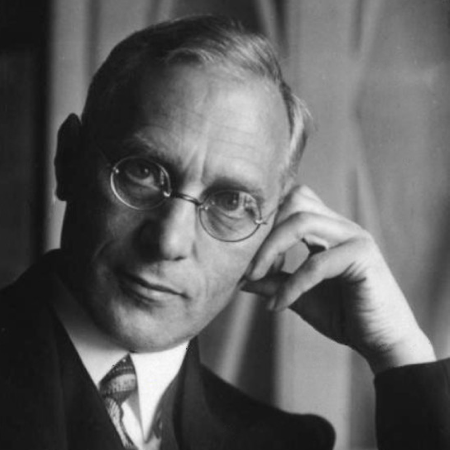
Begin with the question
What connects food
with the whole body?
Clinical observation. Dietary experimentation. A developing theory.
Gerson’s mature program grew out of a much longer medical career.
His bibliography includes early work on bromoform poisoning, neurological conditions and the use of diet in tuberculosis. The 1910 paper preserved here is a reminder that his published record began before the cancer treatment for which he became best known.
In his 1946 testimony, Gerson described developing a diet for his own migraines, then applying dietary treatment in other conditions. His account linked those experiences to a widening interest in the body’s resistance, the quality of food and liver function.
Gerson · First-person account, 1946
That is the author’s narrative of development. Keep it beside the dated papers, which show what he published at each stage. Later summaries sometimes compress decades of changing practice into a single fixed “Gerson protocol.”
Two connected lines of inquiry
Nourishment.
Metabolic function.
Learn what each idea meant in Gerson’s writing before following the relationship he proposed between them.
A concentrated
dietary program
Vegetables, fruit, juices and carefully selected meals formed the visible center of his approach.
- Food quality and growing conditions
- The composition of the diet
- The work of preparation and intake
Salt, potassium
and the liver
He interpreted illness through changes in metabolism and proposed treating the body as an interconnected system.
- Sodium and potassium balance
- Fluid handling and tissue function
- The liver’s place in his theory
Gerson argued that changing the conditions of the whole body was central to treating the person. His reports combined several interventions; a reported outcome cannot be assigned to a single juice, mineral or procedure without additional evidence.
The food program
More than a juice.
More than one ingredient.
Gerson’s dietary work changed across time and clinical settings. Read the early tuberculosis papers, the 1946 testimony and the later cancer publications in sequence. A description from one period should not silently become a rule for all the others.
Today’s Institute materials describe a program built around organic produce, fresh juices, prepared meals and additional therapeutic components. That is a present-day institutional description, not an unchanged transcript of everything Gerson did.
Food quality has an engaging practical side: know the grower, understand the harvest and learn to prepare the ingredient. The organic-food and kitchen guides are accessible routes into that part of the legacy.
A therapeutic regimen adds questions that ordinary cooking cannot settle. Nutritional adequacy, weight change, kidney function, medicines and the treatment of the underlying disease require individual clinical attention.
Explore the soil-to-table field guideThe physiological inquiry
The liver.
The wider system.
A recurring theme in Gerson’s account of illness.
In the Senate record, Gerson placed considerable emphasis on liver and digestive function. His later cancer writing developed a systemic argument: the visible disease belonged within a larger disturbance of the body’s processes.
Keep the distinction between a biological organ function and a particular treatment claim. The liver has many established physiological jobs; that fact alone does not validate a proposed procedure or cancer regimen.
Coffee enemas and supplements entered this historical treatment system. Their rationale, clinical evidence and risks deserve their own reading rather than being folded into a general enthusiasm for good food.
A defining publication
The fifty
case histories.
The 1958 book is a landmark in the original record.
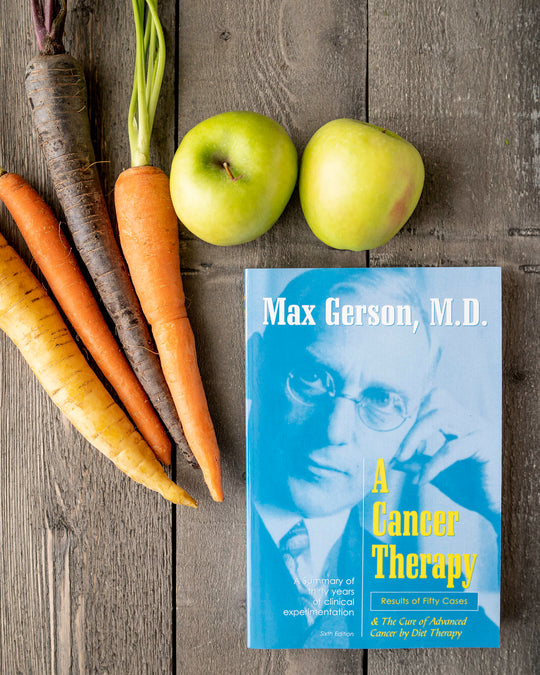
A Cancer Therapy: Results of Fifty Cases gathered Gerson’s mature explanation and selected patient accounts. It remains the natural starting point for readers who want to encounter the argument as he presented it.
whole record.
Diagnosis, earlier treatment, follow-up and the author’s interpretation all belong in view.
A case history can preserve valuable clinical detail and suggest questions for further investigation. A collection of selected cases does not, by itself, establish how a treatment compares with alternatives or what would have happened without it.
Later editions and edited reprints may contain additional material. The archive keeps the 1958 work distinct from subsequent editions and from Charlotte’s similarly named book.
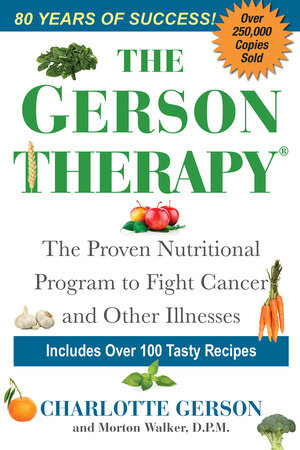
Max Gerson wrote A Cancer Therapy. Charlotte Gerson and Morton Walker wrote The Gerson Therapy. Their relationship is part of the legacy; they are not the same book.
The electrolyte question
From salt and potassium
to later interpretation.
Sodium and potassium became central to Gerson’s explanation of tissue function. Later writers, including Freeman W. Cope, connected his dietary program to Gilbert Ling’s association-induction hypothesis. That was a later theoretical interpretation, not a mechanism demonstrated by Gerson’s case reports.
Three things to keep distinct
Nutrient biology.
Theory. Clinical outcomes.
Potassium
in normal physiology
Potassium is an essential intracellular electrolyte involved in normal cell function. Dietary intake, kidney handling and medicine interactions belong to contemporary nutritional and clinical knowledge.
Sodium
and the historical diet
The low-sodium element of Gerson’s diet appears repeatedly in the historical bibliography. Read each regimen in its period and patient context, rather than assuming that more restriction is always better.
The clinical question
still needs clinical evidence
A plausible-sounding mechanism and a favorable case narrative do not measure a regimen’s effectiveness. The design of a study matters as much as the result quoted from it.
Read the modern studies themselves
What was studied.
What can be concluded.
In 1995, Hildenbrand and colleagues published a retrospective melanoma review involving 153 adults. They reported favorable stage-specific survival compared with published historical groups. The comparison was not a randomized trial, and survival impact was not assessed for their stage IVB group.
Hildenbrand and colleagues · Original study abstract
In 2007, Molassiotis and Peat reported an analysis of six cancer case studies involving people who followed the Gerson therapy. It offers individual histories, not a general success rate.
Molassiotis and Peat · Original case-study record
These publications are part of the later research record. Read patient selection, other treatments, follow-up and missing data before carrying a number into a modern claim.
The available clinical evidence does not establish the Gerson regimen as an effective cancer treatment. Its historical study should not delay diagnosis or established cancer care. Discuss any complementary approach with the treating team. NCI clinical summary (reference page; no longer updated).
The food interest that brings many readers here can stand on its own: learn the vegetables, meet the grower, cook with care and build a varied table that suits your needs. Those are worthwhile skills without turning each ingredient into a cancer claim.
Use the original research to deepen your understanding of the history. Use current clinical knowledge and your care team for decisions about illness. Both deserve more attention than a slogan or a single success story.
Take the details seriously
Questions that
honor the work.
A careful archive gives you the means to read a claim in its full setting.
Is this Max Gerson’s own publication?
Check the author, year and edition. A later foreword, modern web page or narrated reading belongs to its own creator.
Is the complete source available?
The catalogue distinguishes preserved files, reading routes held elsewhere and citations awaiting recovery. A bibliography entry is not a recovered document.
What kind of evidence is it?
Separate a case report, a retrospective review, a theoretical paper and a controlled trial. Their designs support different conclusions.
What matters for personal use?
Your diagnosis, treatment, medicines, kidney function, nutritional status and risk of infection matter. Restrictive diets, supplements and invasive procedures need individualized clinical guidance.
Go straight to the source
The research
behind the story.
Follow the publication history. Availability and authorship stay visible in each record.
Eine Bromoformvergiftung
Max Gerson
Cancer Research: Senate hearings on S. 1875
United States Senate; testimony by Max Gerson and others
Effects of a combined dietary regime on patients with malignant tumors
Max Gerson
1958A Cancer Therapy: Results of Fifty Cases
Max Gerson
Five-year survival rates of melanoma patients treated by diet therapy after the manner of Gerson: a retrospective review
G. L. Hildenbrand, L. C. Hildenbrand, K. Bradford and S. W. Cavin
Surviving against all odds: analysis of 6 case studies of patients with cancer who followed the Gerson therapy
A. Molassiotis and P. Peat
An independent historical reading guide. Gerson’s claims, later interpretations and clinical study results retain their authorship. Opening portrait: Gerson Institute. Sources reviewed November 28, 2026.